Showing posts with label Moo. Show all posts
Showing posts with label Moo. Show all posts
Wednesday, June 22, 2011
Bummer!
One of the many reasons that I love living where I do. Animals give kids a sense of responsibility and a good work ethic. Thunder and Boomer (the calves) are our two bums that my kids and my two nieces are raising this spring and summer. It has been a delight to watch them gain confidence by interacting with them.


Wednesday, May 18, 2011
An Evolving Tradition

May arrives with a bustle of activity every year. Calving season is winding down and crops are going in to the ground. Inevitably, a rain storm hits and puts the brakes on the tractors for a few days. With field work grinding to a halt (not that there has been much of that anyway with this extraordinarily wet spring), a good day for a branding of the calves arises. Branding is the same from year to year: the herd is rounded up, calves are sorted off and tended to, and the pairs are parceled off to their respective pastures for the summer.

Yes, while the end result was the same and many of the sights and sounds were the same as they've been for the last 100 years of modern life in the west, some things for our family were different. For Danish Cowboy, it started off with his mode of transportation. Red Feather still had a bit of spring in his belly and rounding up the cattle was a bit more of an adventure with his new mount. Joe, his pensioned horse who has racked up 27 years of life, seemed to enjoy watching the events from the sidelines.


Of course, there were a few calves that were too small to successfully hold them on the table so they were caught and branded the traditional way. It was a good refresher for Danish Cowboy to have to wrestle a calf to the ground: it's usually a sport for high school boys but even the young at heart an play once in a while.

Some things never change, though. The mama cows still voiced their disapproval and worry.

And the babies quickly found their comfort with mama after the job was done.

No one knows how life will change and traditions such as branding will evolve over the next few years. But if my little people have anything to do with it, they'll be right in the mix trying to do their part. It was pretty tough explaining to a three year old that he couldn't round cows up on his bike. "Give it a few years, little buddy," we told him. Then we can all mount up together.
Sunday, April 3, 2011
Spring, Finally

They arrive during the day amidst tractors feeding hay, four wheelers zooming about, and the constant hum of a farm that is preparing for the work of spring.

They arrive in the cool stillness of the night, the shiny afterbirth that covers them glistens in the spotlight that checks them at 10:00, 2:00 and 6:00. Their mothers are bred to be attentive, protective, and loving and the wet, floppy calves are licked dry and encouraged to stand within minutes of their arrival.

The pairs are left together in the calving pasture for a day or two at most and then are released to a larger area if mother and baby appear to be healthy. Mother cows, so solemn and peaceful throughout the winter, have a change of heart about the presence of humans after their babies are born in the spring. We move about them cautiously, thankful that their protective instincts will keep the calf safe over the coming months, but fully aware of what a charging cow is capable of.

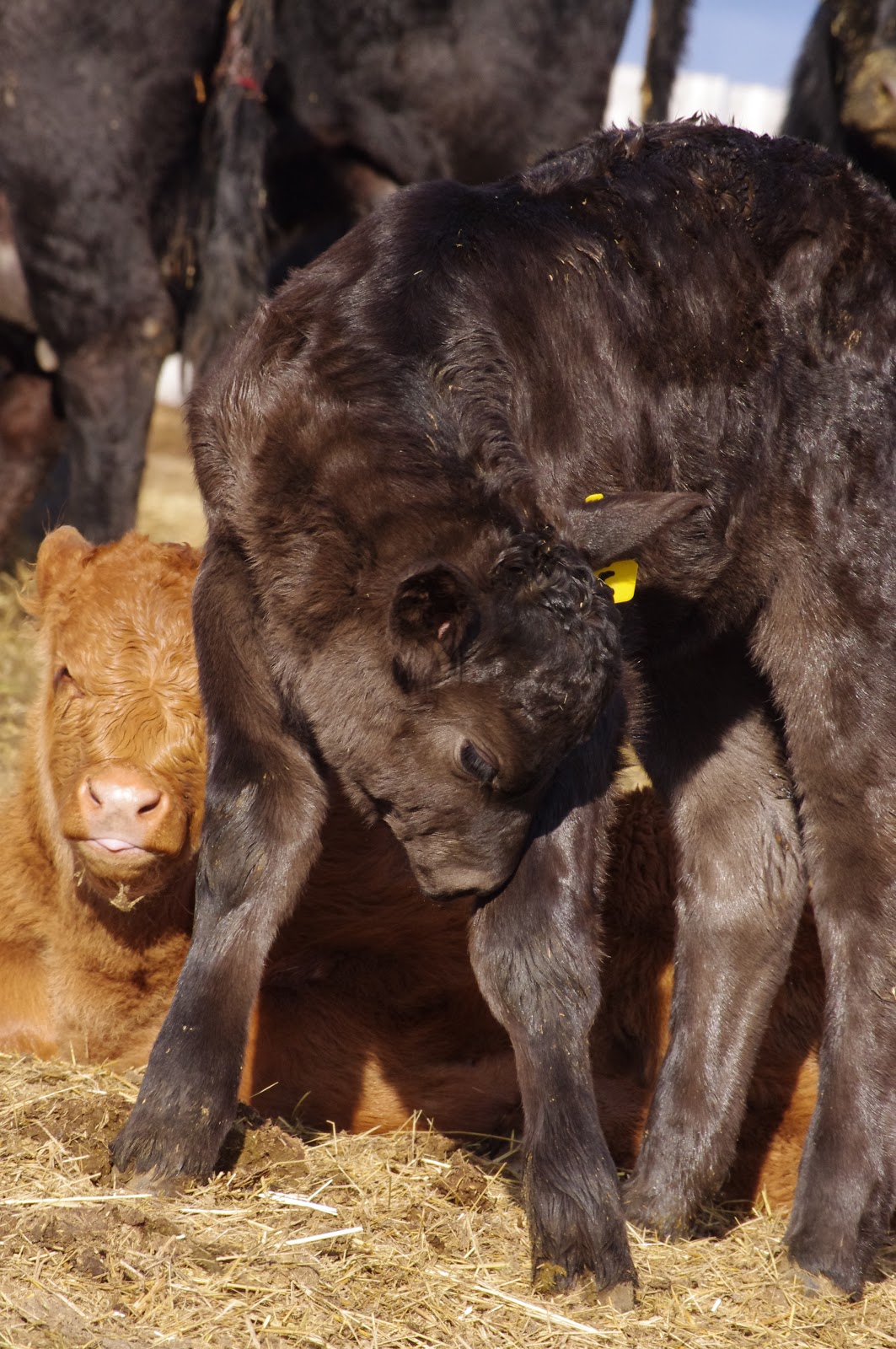
The calves are still small enough to be cute,

and there is love in the air between these mothers and their newborns. You accuse me of anthropomorphism, but have you ever heard the soft beller of a cow that is talking to its babe that has wandered too far away?


We love calving season around these parts. There are moments of sadness that any livestock operation experiences but mostly, mostly, you just feel lucky to take part in the miracle of spring as it happens repeatedly. The birth of every calf is one of those moments that Danish Cowboy and his brother work year round for and to me, each one is a little celebration.
Thursday, January 27, 2011
Cud

We're in the depths of hay feeding season out here on the outskirts of my little time warp town, and are those cows ever lucky that we love them. It's been frightfully cold, snowy and windy. When it turned 30 degrees yesterday, I was loading up some supplies at the store and felt as though I should have purchased spring gardening projects: it felt that warm out.


No would be the correct answer here, and for good reason. If you're a veterinarian or other type of animal scientist (or a rancher for god's sake), please stop reading now. I don't want to embarrass myself.

Us people, we only have one stomach (a monogastric system, if you will). We tend to choose foods that provide us with a variety of nutrients. Cows, and other members of the ruminant family such as deer and camels, have developed a digestive system that has a stomach which is comprised of four major compartments. Evolutionary biologists theorize that this happened because it allows these types of herbivores to thrive on relatively poor qualities of forage. Along with this adaptation came the presence of micro-organisms and protozoa that exist within a ruminant's digestive system that allow them to break down cellulose and form proteins from foodstuffs that would be useless for humans.

This doesn't mean that ruminants can survive on moldy hay and prarie dust, though. They ideally need good hay that has appropriate protein and crude fiber content (yes, even though it's a weird idea to wrap your head around, grass does have a protein content). So we feed them hay in the morning, they meander over to the water tank for a drink, come back to the hay ground and lay around in the uneaten warm forage and regurgitate their food. This ruminant digestive system requires that they masticate all of the forage that they've consumed by bringing it back in to their mouth and chewing, sometimes several times over, in order to allow the latter of the two stomach components to properly absorb all of the nutrients. It's called chewing their cud and they don't do it just because they're bored. It's just what the little evolutionary bug told them to do.

Ruminate on those facts for a while.
Monday, November 22, 2010
Cold, Happy Cows

The problem with an amazing autumn filled with beautiful evenings and more horse time than I've had the opportunity to experience in a great while is that it comes to an end. A brutal and cold end marked by blowing snow, temperatures that struggle to rise above zero degrees for several days and the chopping of ice in the late autumn pasture used by our cows before they return home. You don't chop ice, the cows don't drink. It's a simple equation to solve.

It's easy to get daunted by by the miles of frozen, winding river that were open water just days ago, the wind whipping across the prairie, and the knowledge that another long winter has finally arrived and we need to settle in for the long haul. You are reminded on days like this just how close this land remains to raw wilderness. You are also reminded why there is an entire closet in the basement devoted solely to winter clothing gear.


They've been known to break down the gate, though. Danish Cowboy once got a call from our neighbor to tell us that our cows were hoofing it down the Green Trail and headed the two miles west towards home, all of their own accord. As I've said before, they do dumb things, but they are not stupid creatures.

I then stand aside and watch him try to push 1500 pounds of bale off the back of the pick-up. I then get dirty looks until I put my camera down and help him push, thus making some cows very happy but missing the great action shots of the hay bale shooting down the hill with cattle in hot pursuit.

Gravity does most of the work in rolling out the hay. Cows do the rest.

Happy cows. It's all about having happy cows. Welcome to winter, friends.
Thursday, November 4, 2010
Growing Up


The heifers that we choose to keep for our herd (based on birth size, structure, their mother's milking qualities, and perhaps cuteness if I'm there when we are tagging them) are driven directly to the corrals by our house and dropped off. In the days' prior to their arrival, preparations were underway (not unlike bringing a new baby home from the hospital) to ensure the corrals were sturdy enough, food was available and hazards were removed.

They are dropped off in the corrals and the chaos begins. They bawl constantly at first and then as a group seem to settle down.

Then one remembers and they start all over again. It goes on for days. They stand by the gate and give us these forlorn looks as we go about our daily duties. They are curious and skittish all at once.

They do eventually settle in to their new routine as teenager cows. They'll hang out as a group for the next two years. A gang of wild fur, hair and hooves.

Everyone says that the weaning process is hard those first few days, but eventually something clicks and they forget. I watched a show once that suggested that cows don't forget. That when they are reintroduced to the herd as two year olds they retain a special bond with their mother if she's still in the herd. I like that idea. Cows sometimes do dumb things (just like people), but it doesn't make them stupid creatures.
Monday, October 4, 2010
The Perfect Day


So on Saturday morning, Danish Cowboy and the other adults in the party headed out at daybreak to gather a portion of our cows out of the pasture and head them east towards home so that the calves can be conditioned prior to shipping them in a few weeks. I was left behind with the kids and horses (which tend to merge into one on some days in terms of money spent, frustrations caused, tears shed, and love expended) to meet them at about the halfway point. Three riders, three four wheelers, a side-by-side utility vehicle and two pick-ups with horse trailers comprised our group.

The cows didn't have a chance.

Argo behaved.
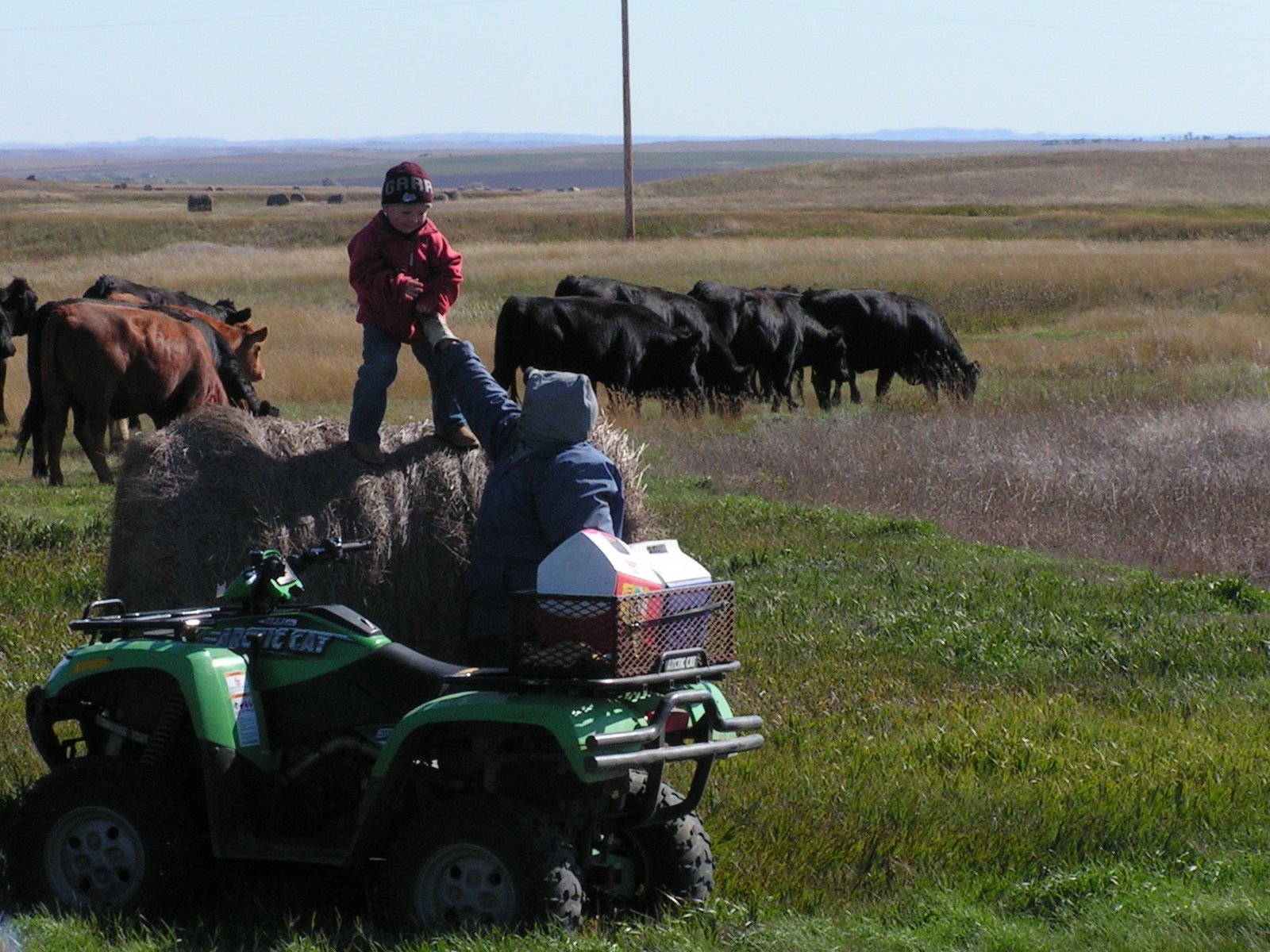
My kids got to hang out with their favorite people and do things that would ordinarily send fear into their mother's heart.

These are the reasons that I love living here: fresh air in your face while on the back of a good horse, the opportunity for horseback photography, calves trying to steal some of their mother's milk while everybody is on the move, the exhaustion that hits you when you return to the house, the knowledge that we are just days away from wrapping up another year of production. It's a good life.
Monday, March 29, 2010
Weekend Education

The weekend is over and what an eventful one it was. I feel fortunate that it was also an informative one for me. Here's what I learned: Number one is that spring is here. The bunch grasses are slowly greening up around their crowns, the animals are wandering farther from their hay in search of fresh pasture. The whole prairie will soon turn from a monotonous shade of brown to a verdant green.
 The number two item that I learned from my kids is that I can make a calf. It's true. Danish Cowboy and the kids were out on the tractor on Friday evening feeding. A cow was having a very difficult time calving and had become hiplocked (the calf's hips fail to pass through the mother's pelvis). Danish Cowboy motioned me out on the four wheeler and while he took it back to the barn to gather the necessary equipment to help the calf out, the cow laid down on her side and began pushing. I pulled mightily in time with her contractions and out popped baby calf, much to the kids' delight! I was told all weekend that I had made a baby calf. Such powers! And then I ran a different cow through the fence and we had to fix the mess that was made. However, I promptly returned to gloating over my calf-making abilities all through dinner.
 The number three item I learned is that apparently, unbeknownst to me, I am pregnant. Unlike my calf-making powers, this is not true. You can imagine my mother-in-law's surprise when she heard second-hand that she was going to be having another grandchild. You can imagine Danish Cowboy's surprise when he learned (third-hand?) he was going to be having another kid. And you can imagine my eyes rolling uncontrollably when I learned (fourth-hand?) that I was with child. No word yet on when the kid is due or if it is even limited to one kid. I'll keep you posted if I hear anything.
Number four revelation for the weekend: Having potty trained twins is awesome.
 Yes, awesome with one exception. When you live in the country there are few restrooms available and they learn early on that sometimes you have to go potty al fresco. And then they decide that EVERY time they go potty, it should be outside. So when I leave them outside to play for a few minutes all by themselves, I can rest assured that one will soon be squatting in the gravel and the other will be delightedly seeing just how far he can make that stream reach.
 Much like Lewis and Clark in this very same region 200 years ago, they are constantly searching out new places to mark their territory.
 After all, the cows seem to consider the world their restroom, why shouldn't we?
Yes, awesome with one exception. When you live in the country there are few restrooms available and they learn early on that sometimes you have to go potty al fresco. And then they decide that EVERY time they go potty, it should be outside. So when I leave them outside to play for a few minutes all by themselves, I can rest assured that one will soon be squatting in the gravel and the other will be delightedly seeing just how far he can make that stream reach.Much like Lewis and Clark in this very same region 200 years ago, they are constantly searching out new places to mark their territory.After all, the cows seem to consider the world their restroom, why shouldn't we?
Subscribe to:
Posts (Atom)